Court Enforcement Document
An integrated digital public service in the Diia app
#GovTech Case Study2026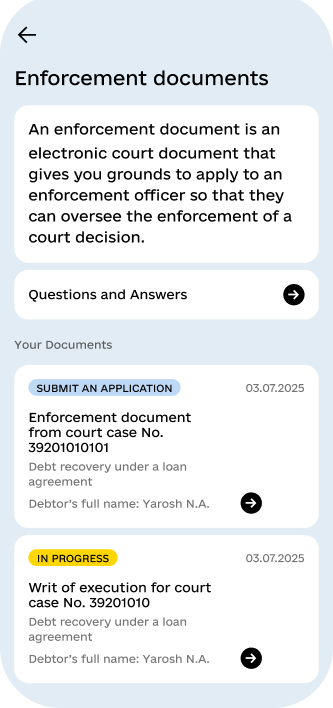
Court Enforcement Document
The case shows how AMEDIA moves one of the most paper-bound stages of justice into the digital domain: a court ruling is no longer a document the person must physically carry to an enforcement officer — it moves forward automatically, and the human role narrows to a few deliberate choices.
01 — OVERVIEW
From a court ruling to an open enforcement proceeding, on a phone
Court Enforcement Document is an integrated electronic public service of the Unified State Web Portal of Electronic Services, delivered through the Diia mobile app and live in production since 14 August 2026, following a public beta testing phase.
The service lets a person who has won a court case receive the electronic writ of execution on their phone and immediately submit it for compulsory execution to a state or private enforcement officer — with no visit to the court or to the enforcement service.
Purpose of the product
Cover the full cycle in one place: receiving the document from the court, generating and signing the application, delivering it to the enforcement officer, and tracking the status of the enforcement proceeding.
What the product changes
An offline process requiring several institutional visits is replaced by a seven-screen flow on a phone, and for the first time judgment creditors see how their own court ruling is actually being enforced.
02 — WHO IT'S FOR
The judgment creditor, the courts and the enforcement service
Primary user
The judgment creditor — an individual in whose favour a court ruling was issued and who is entitled to initiate its compulsory enforcement.
Eligibility
Ukrainian citizenship, a registered individual taxpayer number, a ruling in legal force subject to compulsory enforcement, an activated Diia.Signature, and an electronic enforcement document not yet submitted through another channel.
Indirect beneficiaries
Courts and the State Judicial Administration — less paper handling; state and private enforcement officers — structured, machine-readable applications; the state — measurable statistics on how rulings are enforced.
03 — THE PROBLEM IT SOLVES
A chain of offline steps between a ruling and its enforcement
Before the service existed, the path from a court ruling to an open enforcement proceeding was a chain of offline steps. In Ukraine this problem is measured in millions of cases per year.
A personal visit to the court to collect the enforcement document → the document arrives in the app automatically with a push notification
Finding the right enforcement officer and jurisdiction yourself → Diia lists the officers with jurisdiction over the address you specify
Re-typing case data into a paper application → data is pulled automatically from state registries and from the document itself
A handwritten signature and delivery by post → signing with Diia.Signature and instant delivery to the enforcement system
No visibility into the status → statuses and rulings online, with push notifications on every change
04 — CORE FUNCTIONALITY
Documents, applications and statuses in one module
List of enforcement documents
All enforcement documents received from the judicial system, shown as cards with statuses.
Document details
Case data, category and type of recovery, issuing court, ruling number in the state register, debtor data, judges, and the signature verification status.
Download of originals
The original enforcement document together with its electronic signature, downloadable as a single archive.
Rulings tab
A separate tab listing the rulings issued within the proceeding, with details and downloadable archives.
End-to-end statuses
Ready to submit, in progress, completed, cancelled and submission unavailable — with a manual refresh available once every 24 hours.
Notifications and re-submission
Push notifications on registration, acceptance, rejection, lack of updates and technical failures; re-submission if the officer returns the application.
05 — SUBMISSION IN SEVEN STEPS
Everything the user decides, and nothing more
Seven steps between an enforcement document and an open proceeding:
Debtor's address
Region, district and settlement, or the location of the debtor's property.
Enforcement officer
Chosen from a list of state and private officers filtered by that address.
Bank details
An IBAN for receiving the recovered funds; shown only for monetary recovery.
Contact details
A phone number pre-filled from BankID, Ukraine's bank-based identification scheme.
Creditor's address
Shown only when the address could not be retrieved from the State Migration Service register.
Attachments
An optional court ruling together with its signature file; the step can be skipped.
Review and signing
A preview of the generated application, signed with Diia.Signature.
06 — HOW THE PRODUCT WORKS
One point of interaction with the judicial and enforcement systems
The service is a module of the Diia portal; the user never works with any registry directly:
Document arrives
The court issues an electronic enforcement document; Diia retrieves it and sends a push notification (UJITS / e-Court).
Application is generated
Case and debtor data come from the document, the creditor's address from the registry, the phone from BankID, the bank from the IBAN.
Officer is selected
A list of officers with jurisdiction over the address is built from the directory; if none serve that settlement, district-level officers are shown.
Signing
The user signs the generated application with a qualified electronic signature (Diia.Signature).
Delivery
The signed application is sent to the Automated System of Enforcement Proceedings, registered and routed to the chosen officer.
Feedback loop
Diia periodically retrieves status updates, return reasons and rulings, and surfaces them to the user.
07 — STATISTICS AND SCALE
The market and the platform in numbers
08 — PRODUCT ADVANTAGES
Eight reasons the process now holds together
Fully online
The entire path from receiving the document to handing it to an enforcement officer happens on a phone.
Minimal manual work
The application is generated automatically; the user only reviews the data and picks an officer.
Legally binding
The application carries a qualified electronic signature and has the same force as a signed paper one.
Transparent
Statuses, refusal reasons and rulings are visible in the app, and changes arrive as push notifications.
Freedom of choice
The user selects a state or private enforcement officer from a relevant, jurisdiction-aware list.
Error-resistant
IBAN and phone validation, attachment format control, and blocking of duplicate submissions.
Accessible justice
The service works identically anywhere in the country, including for people who cannot visit an institution in person.
One entry point
One familiar app instead of three separate systems.
09 — INTEGRATIONS
Seven systems behind one screen
The service connects the judicial system, the enforcement system and supporting state services:
UJITS / Electronic Court — source of enforcement documents: list, details, document and signature files, and the submission flag
Automated System of Enforcement Proceedings (ASEP) — receives signed applications; provides statuses, return reasons, rulings and officer directories
Diia.Signature — qualified electronic signature on the application, a mandatory part of submission
State Migration Service — automatic retrieval of the judgment creditor's registered address
BankID — identity and contact verification during authentication; pre-filling of the phone number
Ukrainian bank directory — IBAN validation and bank identification from open National Bank of Ukraine data
Diia notification service — push notifications about new documents and status changes
10 — TECHNOLOGY STACK
Open source, client–server, a module of the Diia portal
Diia mobile app (iOS, Android); responsive interface based on the Diia design system; thin-client principle.
Modular client–server architecture separating logic from interface, with open APIs and horizontal scalability.
REST interfaces and a RabbitMQ integration bus; an intermediate service for communication with the judicial system.
PostgreSQL as the primary store, Redis for directory caching.
Qualified electronic signature in CAdES-X-Long format; authentication mechanisms based on id.gov.ua.
Docker containerisation, Kubernetes orchestration, CI/CD-based deployment.
Logging at both system and application level, covering user actions and errors.
11 — PROVEN RESULT
A paper stage of justice moved into the digital domain
The service has been live in production since 14 August 2026, connecting the judicial system, the Diia app and the enforcement system in end-to-end electronic interaction, and replacing an offline process of several institutional visits with a seven-screen flow on a phone.
Product analytics measures not only volume but the quality of the process — status dynamics, first versus repeat submissions, the split between state and private officers and the structure of refusal reasons — creating a feedback loop for the compulsory enforcement system itself.