Employment Certificate
An electronic certificate from the place of work in the Diia app
#GovTech Case Study2026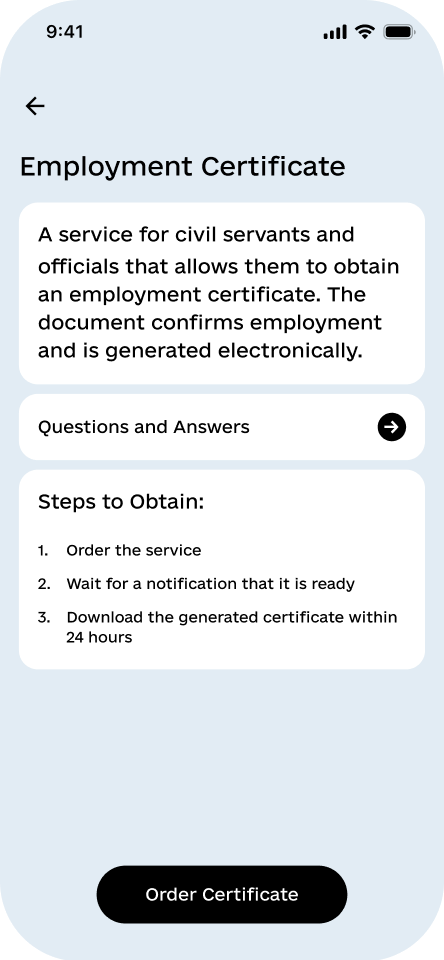
Employment Certificate
The case shows how AMEDIA turns a routine HR procedure into an automated public service that issues a legally valid document within minutes, directly on the employee's phone — and how every new authority connected to Diia.Office receives that service ready-made, with no separate development.
01 — OVERVIEW
A legally valid certificate in one tap
Employment Certificate is a digital public service within the Diia ecosystem, delivered in the "For Civil Servants" section (Diia.Office) of the Diia mobile app and live in production since 12 August 2026.
The service lets civil servants and public officials request a certificate confirming their place of work and position and receive it instantly as a PDF — with no paper application, no request to the HR department and no in-person visit.
Purpose of the product
Turn confirming employment and position into a self-service digital transaction available at any time and from any location, without involving the HR department.
What the product changes
The certificate is generated from Diia.Office data, stays available for viewing and download for 24 hours and can be verified by QR code; the PDF carries the same legal force as a certificate issued by the employer on paper.
02 — WHO IT'S FOR
Civil servants and the HR departments behind them
Primary audience
Civil servants and public officials — employees of the Secretariat of the Cabinet of Ministers, ministries, other central executive authorities and their territorial bodies, local executive authorities, other state bodies and the NSSMC.
Eligibility conditions
An active Diia user with a verified individual taxpayer number, current civil service status or identification as a public official, and an employing authority connected to Diia.Office with the "For Civil Servants" section in the app.
Authorities and HR departments
Connected at launch: the Ministry of Youth and Sports, the NSSMC, the Ministry of Health, the Ministry of Digital Transformation and the state-owned enterprise Diia — with the list expanding; HR departments lose the routine manual handling of certificate requests.
03 — THE PROBLEM IT SOLVES
A document needed repeatedly, issued slowly
An employment certificate is one of the documents a civil servant needs repeatedly and regularly — for a bank, social benefits, education, medical services, a visa application or a rental agreement. It used to work like this:
A paper request submitted to the HR department
Waiting for the document to be prepared — typically 1–3 business days
Collecting the certificate in person or having it forwarded
Repeating the entire procedure for every new certificate
04 — CORE FUNCTIONALITY
Order, status, document, verification
One-tap ordering
Access through the "For Civil Servants" section with an onboarding screen and FAQ; the user enters and confirms no data at all.
Transparent statuses
A status screen showing In progress, Certificate ready or Not issued, together with the request date and time, plus push notifications on readiness, refusal or a temporary technical error.
The document
Viewing and downloading the finished PDF, available for 24 hours, with verification by scanning a QR code with a smartphone camera.
Meaningful refusals
Specific reasons instead of a generic error: employee not found, insufficient data to generate the certificate, employment terminated or employment temporarily suspended.
Limits and re-ordering
One active request at a time and up to five orders per 24 hours to protect the registry, with re-ordering once the previous request has completed its lifecycle.
Accessibility and feedback
A Ukrainian-language interface aligned with the Diia design system, WCAG 2.1 AA contrast, alt text, 44×44 tap targets and screen-reader support, plus an option to rate the service.
05 — HOW THE PRODUCT WORKS
Five steps, four of them invisible
The user journey from opening the service to a downloadable document:
Sign in
The user signs in to Diia and opens the service in the "For Civil Servants" section.
Order
They tap "Order certificate" — the system creates the application automatically.
Request
The service module sends a request to Diia.Office via API.
Generation
Diia.Office validates the employee data, generates the PDF certificate and returns the result asynchronously.
Delivery
Diia updates the status, sends a push notification and opens the document for viewing and download.
06 — REQUEST LIFECYCLE
Six states the system handles on its own
Sending
The application is created and the request is dispatched to Diia.Office; failures trigger automatic retries — the user sees "In progress".
Sent
The request is registered and the registry's asynchronous response is awaited — still "In progress".
Accepted
The certificate is generated from Diia.Office data and the PDF is delivered to the app — "Certificate ready" with the document.
Rejected
The certificate could not be generated and the reason is passed to the app — "Not issued" with the reason.
Closed
The document's availability window has ended and the data is cleared — the certificate can be ordered again.
Expired
The permitted waiting time for the registry response was exceeded — the certificate can be ordered again.
07 — STATISTICS AND SCALE
The ecosystem and the service
08 — PRODUCT ADVANTAGES
What the service changes on both sides
Speed
The cycle shrinks from several business days to a few minutes.
Zero paper
Application, processing and issuance happen entirely in digital form.
Transparency
The user sees the status at every stage instead of waiting blindly.
Legal equivalence
The PDF matches the paper certificate and is verifiable by QR code.
Meaningful refusals
Instead of a generic error, the user gets a specific reason and can act on it.
Data minimisation
Personal data is retained only as long as the service requires, then cleared automatically.
Relief for HR
A routine request no longer needs manual handling by the HR department.
Accessibility
AA-level compliance with TalkBack and VoiceOver support.
Scalability
Connecting a new authority to Diia.Office requires no rework of the service.
09 — INTEGRATIONS
Seven systems behind one tap
The service module orchestrates the HR system, identification services and the Diia platform services:
Diia.Office — primary source of employment and position data; verifies employment status and generates the PDF certificate
id.gov.ua — user identification and authentication, secure access to personal data
State Tax Service — verification of the individual taxpayer number as an eligibility condition
BankID — demographic attributes for anonymised product analytics
Diia Portal notification module — push notifications on readiness, refusal and technical errors
Diia Portal logging subsystem — recording of user actions and errors for security and diagnostics
Diia Portal document verification tools — validation of the certificate via its unique QR code
10 — TECHNOLOGY STACK
Open source, asynchronous, module-based
A dedicated module within the Diia Portal on a client–server model, with algorithmic logic separated from the interface and thin-client access.
Open-source technologies only, with no additional licence requirements.
REST, SOAP and RabbitMQ; asynchronous data exchange between modules with no user involvement; open interfaces for third-party systems.
PostgreSQL, Redis.
Docker containers deployed on Kubernetes, with changes delivered through CI/CD.
Independence from hardware platform and server operating system; horizontal scalability and functional growth through additional modules.
Protection of data in the client–server channel, access segregation, logging at both system and application level.
The Diia design system, responsive layout for phones and tablets, Ukrainian localisation, AA-level accessibility, TalkBack and VoiceOver support.
11 — PROVEN RESULT
A routine HR procedure, now a public service
The service is live in production since 12 August 2026: the document is generated immediately, with no paper application and no processing queue, and the PDF carries the same legal force as one issued by the employer on paper, its authenticity verified by scanning a QR code.
A procedure that took 1–3 business days and required HR involvement is now a few minutes of self-service; every new authority connected to Diia.Office receives a ready-made service with no separate development, and the built-in model of 11 metrics reports volume, quality and average processing time.