Extract from the Register of Veterans
An electronic extract from the Unified State Register of War Veterans
#GovTech Case Study2026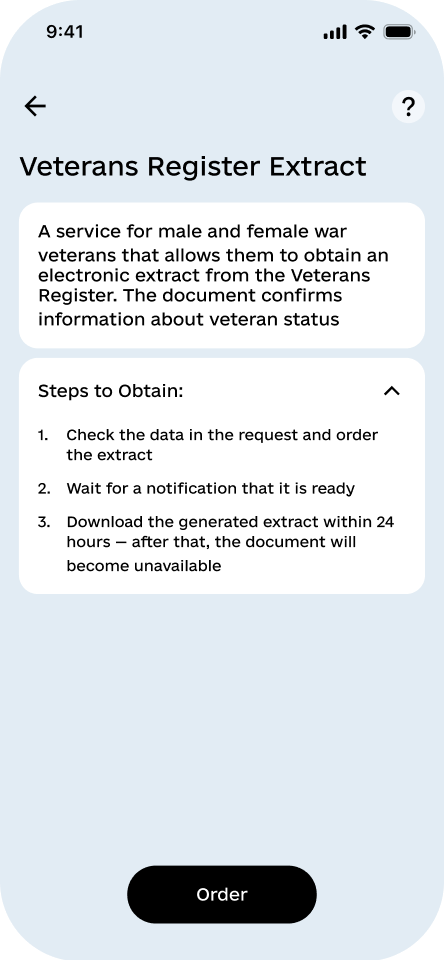
Extract from the Register of Veterans
The case shows how AMEDIA designs a public service around the person rather than the procedure: three taps instead of an application form, the full contents of the request shown before it is sent, an official answer even when the document cannot be issued, and personal data deleted automatically once it is no longer needed.
01 — OVERVIEW
An official extract in three taps, with a QR code
Extract from the Register of Veterans is a public electronic service for obtaining an extract from the Unified State Register of War Veterans through the Diia mobile app, in Veteran Pro — the veterans' section of the app. It is delivered by the Ministry of Digital Transformation and the state-owned enterprise Diia together with the Ministry of Veterans Affairs as the owner of the Register.
A war veteran orders an official extract on a smartphone in a few taps and receives a signed PDF with a QR code — no application form, no visit to a government office, no paper.
Purpose of the product
Give an answer in every case: if the data in the Register is missing or needs correction, the user receives an official document stating that clarification is required, with the reason explained.
What the product changes
Either result — the extract or the clarification notice — is available to view and save in the app for 24 hours, and the request itself is signed by the Diia Portal administrator, so the user is never asked to sign.
02 — WHO IT'S FOR
Veterans, and the institutions around them
War veterans
People whose data is recorded in the Register: combat veterans, persons with a war-related disability, war participants, persons recognised for distinguished service to the state, and injured participants of the Revolution of Dignity.
People who need it regularly
Those confirming their status with a bank, employer or educational institution, and when applying for benefits, housing and grant programmes — as well as those for whom an in-person visit is hardest.
Indirect beneficiaries
The network of administrative service centres — a share of requests moves to the digital channel; the Ministry of Veterans Affairs — anonymised analytics on demand and on the quality of Register data.
03 — THE PROBLEM IT SOLVES
Five things that stood between a veteran and a document
Before 2025 an extract meant a written request to the ministry and a wait of more than 30 days; from 2 January 2025 it meant an in-person visit to a service centre — about five minutes on site, but travel, a queue and a physical document were still required.
The physical barrier — for someone recovering from an injury, still serving or living far from a service centre, five minutes is not five minutes
Repetition — the extract has limited currency, and every re-confirmation of status used to mean another visit
An opaque request — the person could not see which of their data was sent to the Register, or where the request stood
A dead end when data is incomplete — an incorrect or missing record was discovered only on site, with no clear explanation of what to do next
Manual data entry — filling in personal data by hand produces errors and rejections
04 — CORE FUNCTIONALITY
Ordering, transparency and safeguards
Three actions, no form
The whole path from opening the service to a submitted request is three actions: open and tap Order, review the pre-filled data and give consent, tap Send request.
No signature from the user
Eligibility checks run, the application is created and the Diia Portal administrator's qualified electronic signature is applied automatically before the request goes to the Register.
Full request transparency
Before anything is sent, the user sees the complete contents of the request and the source of every field — full name and taxpayer number from state registers, phone and email from the profile.
Explicit consent and cancellation
The Send request button stays inactive until consent to personal data processing is ticked, and a Cancel request action with a confirmation step is available from the same screen.
The result and its verification
The extract is generated on the Register side as a PDF signed by the Ministry, carrying a QR code that opens the Ministry's verification page; it is available to view and save for 24 hours.
Limits that explain themselves
One active application at a time and up to five requests within 24 hours, with dedicated screens for age under 14, a missing or unverified taxpayer number and an expired extract.
05 — ORDER STATUSES
Five states, each with an available action
Sending request
The application has been created and is being transmitted to the Register; temporary failures trigger automatic retries. The user can view the status or cancel the request.
In processing
The request has been registered in the Register of War Veterans and the extract is being generated. The user can view the status.
Extract ready
The PDF with a QR code has been generated and delivered to the app. The user can view and save it for 24 hours.
Clarification required
The extract cannot be issued in its current form; a PDF explaining the reason has been delivered and is available for 24 hours.
Not received
The waiting time for a response has elapsed and the extract can be ordered again.
06 — HOW THE PRODUCT WORKS
One request, then nothing to do
The service is an asynchronous module in the Diia Portal architecture; after the single request everything runs without the user:
Identification
The user is identified and authenticated in the Diia app.
Taxpayer number
The State Register of Individual Taxpayers validates the number against the date of birth and full name.
Access checks
The app checks for a digital veteran ID and access to the Veteran Pro section; the module checks age, active applications and the daily limit.
Status and signing
The Register of War Veterans confirms an active veteran status; the module builds the request and applies the Portal administrator's signature.
Generation
The Register looks up the data and generates the PDF extract with a QR code and the Ministry's signature.
Delivery and verification
The module receives the PDF, updates the status and sends a push; any third party can verify the document via the QR code.
07 — STATISTICS AND SCALE
The audience and a pattern already proven at scale
08 — PRODUCT ADVANTAGES
Before and with the product
Channel
An in-person visit or a letter to the ministry becomes a smartphone, anywhere, any time.
Application form
A request to fill in with documents attached becomes no form at all — only reviewing and confirming data.
Identification
A passport in hand becomes electronic identification in Diia, with no user signature required.
Request transparency
The contents of the request were never shown; now the full contents and data sources are visible before sending.
Process visibility
There was no way to tell where the request stood; now there are five clear statuses and a push at every change.
Incomplete Register data
A verbal refusal with no document becomes an official PDF stating that clarification is required, with the reason.
Document verification
Visual inspection becomes a QR code and the Ministry's verification page.
Data protection
Paper-based handling becomes explicit consent, minimised storage and automatic deletion after 24 hours.
Accessibility
Dependence on service centre hours and location becomes compliance with DSTU EN 301 549:2022, VoiceOver and TalkBack support and AA-level contrast.
09 — INTEGRATIONS
Nine systems behind three taps
The module orchestrates state registers, the signature service and the Diia platform services:
Unified State Register of War Veterans — confirms veteran status, receives the request, generates and delivers the PDF extract with a QR code
State Register of Individual Taxpayers — confirms the validity of the taxpayer number against the number, date of birth and full name
Trembita — the preferred channel for interagency electronic data exchange; where it cannot be used, existing system APIs are permitted
Diia Portal electronic signature service — applies the Portal administrator's qualified electronic signature to the request
id.gov.ua — electronic identification and authentication mechanisms
Diia Portal file service — stores and serves the resulting PDF for the availability period
Diia notification service — push notifications on application status changes
Diia Portal user profile — contact data for the request and anonymised parameters for analytics
Ministry of Veterans Affairs verification page — third-party verification of the document via its QR code
10 — TECHNOLOGY STACK
Open source, asynchronous, BPMN-orchestrated
Client–server module, thin client, asynchronous processing, horizontal scalability, separation of business logic from the interface.
Diia mobile app (iOS, Android), the Diia design system, styled-components.
REST, SOAP and RabbitMQ; automatic exchange between modules without user involvement.
MongoDB, Redis.
A BPMN process for issuing the extract, managing states, timeouts and retries.
Docker images on Kubernetes, CI/CD.
Qualified electronic signature, electronic identification via id.gov.ua, logging at system and application level, protection of data in transit.
DSTU EN 301 549:2022, AA contrast (4.5:1), accessibilityLabel / contentDescription, VoiceOver and TalkBack compatibility.
Up to 70 minutes in the sending state and up to 70 minutes awaiting the result; the document is available for 24 hours, after which personal data is removed automatically.
11 — PROVEN RESULT
An answer in every case, and data that does not accumulate
Veterans get zero visits to government offices for a document that previously required travel, a queue and a passport in hand, three steps instead of an application form, and an answer in every case — even when the extract cannot be issued, the person receives an official document explaining why and what comes next.
For the state, a routine request moves to the digital channel, the number of "clarification required" results becomes a measurable signal of data completeness in the Register, and thirteen automatically collected metrics give a picture of demand, processing time and user profile for veteran policy planning.