Tax Liabilities
Checking and paying tax liabilities in the Diia app
#GovTech Case Study2026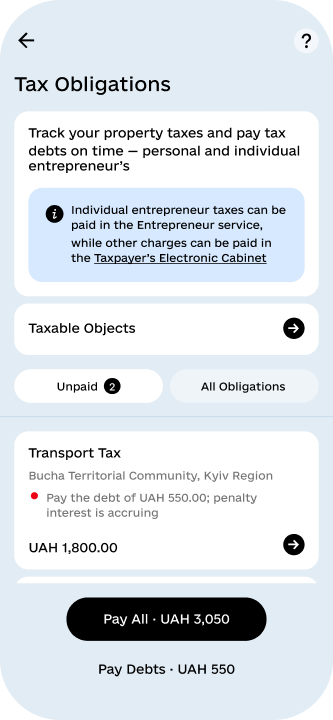
Tax Liabilities
The case shows how AMEDIA builds a reusable pattern for government payments — register → liability → payment → confirmation: the citizen is told the moment an assessment appears, sees every amount broken down to its source document, and pays with details the system generates rather than the person types.
01 — OVERVIEW
A complete tax profile of a citizen in one service
"Tax Liabilities" is a pair of interconnected services in the Diia mobile app, available from Services → Tax Services: viewing and paying property taxes, assessed monetary liabilities and tax debt including accrued interest and penalties, and a "Tax Account Statement" — a consolidated view of the citizen's tax account for each of their taxes.
Both services run on a single data source — the IT system of the State Tax Service — and together form a complete tax profile of an individual: assets, assessments, debts, payments and their outcome.
Purpose of the product
Automate the retrieval and display of information about tax debts and monetary liabilities with the ability to pay them, as well as about the tax account statement and taxable property.
What the product changes
Instead of searching several portals, the citizen is notified as soon as an assessment appears, sees the full breakdown and pays in a few taps — with payment details generated by the system.
02 — WHO IT'S FOR
Six segments, one precondition
Property owners
Owners of real estate, land plots and vehicles see their taxable property from STS registers, assessments per object and the ability to pay.
People served with a notice
A push notification at the moment of service, access to the PDF copy of the notice, the payment deadline and the amount.
People with tax debt
A breakdown of the debt — principal, penalty, late-payment interest — its origin history and a priority payment action.
Self-employed and sole proprietors
Information on tax debt for non-property payments, including the Unified Social Contribution, with the ability to pay.
Citizens abroad
Extraterritorial access to the tax profile without visiting the tax authority where the person is registered.
Non-users of the Electronic Cabinet
A familiar mobile interface instead of an online tax account built for experienced taxpayers.
03 — THE PROBLEM IT SOLVES
Four gaps between an assessment and a paid tax
An individual learns about their tax liabilities late and from scattered sources. This creates four interconnected problems:
Information is fragmented — debt, assessments, taxable property and the account statement live in different sections of the Electronic Cabinet or require a visit to the tax authority
Assessments arrive too late — notices are sent by 1 July and must be settled within 60 days of service, yet a paper notice may not arrive at all
Missing the deadline is expensive — a penalty of 5% to 10% plus daily interest; Ukraine's total tax debt stood at roughly UAH 295 billion as of 1 August 2026
Paying is itself complicated — the budget IBAN, the classification code and the tax authority differ for every tax and every municipality, and an error means the payment does not close the liability
04 — CORE FUNCTIONALITY
From a served notice to a credited payment
Assessments and notifications
STS assessments appear automatically as a card per tax and per taxable item, and a push in the "Taxes" category arrives the moment an assessment notice is served, delivered between 9:00 and 19:00.
Tax accounts at a glance
All open tax accounts in two tabs — "Action needed" with a counter and "All liabilities" — each card carrying the tax name, municipality, amount and a colour-coded status.
Colour-coded statuses
Red for outstanding debt with interest accruing, yellow for a served liability with a deadline or an advance payment, blue while funds await crediting, green for no arrears.
Drill-down to the document
Assessment details with the notice number and date, the taxable property, a step-by-step calculation and a PDF copy of the notice; debt details with principal, penalty and interest as at a date.
Four payment scenarios
Recommended amount, partial payment allocated in the statutory order, advance payment into the tax account, and batch payment of all accounts confirmed once.
Payment tracking
Two transparent statuses — being confirmed by the bank, then being credited by the tax service — after which amounts are recalculated and a PDF receipt is generated.
Taxable property
Cars, apartments, houses and land plots exactly as held in STS registers, so the user can check what the register says about their property.
Tax account statement
Four consolidated indicators per tax — assessed, paid, overpayment and arrears — with the date the data is current as of.
05 — HOW THE PRODUCT WORKS
A thin client over state registers
The product is not a source of data: it displays STS information and returns payments to it.
Entry and checks
The system verifies STS availability and the taxpayer number check result, then composes the list of liabilities.
Data retrieval
The request to the STS system goes through Trembita; liabilities are received broken down by budget classification code.
Classification
The classification code determines the account type: for property taxes both assessments and debts are shown, for other taxes debts only.
Amount due
A coverage algorithm applies existing overpayment and payments in processing; if they cover the assessment in full, no liability is displayed.
Status
The account receives a status by priority — debt, assessment notice, paid, no arrears — which drives the marker colour and the wording.
Payment
The payment module composes the payment from the relevant budget account details and processes it through the Ukrgasbank payment system.
Reconciliation
The internal payment service matches its payments against STS account operations; a matched payment stops being treated as in processing.
Notification
The notification module sends a push within the 9:00–19:00 window after validating the user's push token.
Analytics
Every payment creation and status change is recorded in internal storage for anonymised product analytics.
06 — STATISTICS AND SCALE
Context, potential and operational targets
07 — PRODUCT ADVANTAGES
Nine things the citizen no longer has to do
Proactive, not self-checked
A push arrives the moment a notice is served, so the citizen learns about the assessment straight away rather than months later.
One place, not several portals
Debts, assessments, taxable property, operation history, account details and the statement in a single service.
Payment in a few taps
Debt, liability and interest — separately or in one payment — settled in the app, with no trip to a bank or tax office.
Protection from interest
The notification arrives at the start of the 60-day period, while the liability is not yet a debt.
Transparency to the document
Every amount is broken into components, with a PDF copy of the notice and the documents underlying the debt.
Zero manual details
IBAN, classification code and tax authority data are generated automatically, removing the classic cause of lost payments.
Extraterritorial
The service works identically regardless of the user's location, including abroad.
Accessible to everyone
The interface conforms to DSTU EN 301 549:2022 and is fully in Ukrainian.
Data stays in the registers
The app displays STS information over secure channels; only the account owner has access after verification.
08 — INTEGRATIONS
Eight systems behind one tax profile
The service is built on state registers and the Diia platform services:
STS IT system — primary data source: tax debts, monetary liabilities, interest, account operations, taxable property and the tax account statement
Trembita — the secure state channel for data exchange between the Diia portal and the STS system
Ukrgasbank — the payment system through which payments are processed and their statuses returned
Registers feeding the STS system — the State Register of Real Property Rights, the State Land Cadastre and vehicle data, delivered within the STS response
BankID and Diia portal authentication — user identification and retrieval of the verified taxpayer registration number
Diia push notification module — delivery of "Taxes" category notifications with push token validation
Taxpayer's Online Account — an outbound link for operations beyond the service scope
PDF generation module — payment receipts and copies of tax assessment notices
09 — TECHNOLOGY STACK
Part of the Unified State Web Portal platform
The Diia mobile application for iOS and Android, with the interface built on the Diia design system and components.
A service within the Diia portal platform implementing liability composition, the coverage algorithm, interest calculation and the account status model.
Exchange with the STS system through the Trembita interoperability platform; a separate integration with the Ukrgasbank payment system.
A document-oriented database holding payment and liability statuses and the transaction collection used for analytics.
Server-side generation of payment receipts and rendering of assessment notices as PDF.
The Diia portal push infrastructure with control of the delivery time window.
Collection of anonymised per-transaction metrics in internal storage, with no transfer of personal data to third parties.
Personal data processed under the Law on Personal Data Protection; taxpayer number verification before every session; data displayed from the registers, not accumulated on the application side.
10 — PROVEN RESULT
A reusable pattern for government payments
The citizen learns about an assessment when it appears rather than after the 60-day period has run out, gets a complete picture of their tax position without a single visit to the tax authority, and settles debt, liability and interest in a few taps with correct details and a PDF receipt.
For the state, making payment easier directly affects voluntary settlement of arrears — against a tax debt of roughly UAH 295 billion this is a fiscally significant channel, and because property taxes go to local budgets, faster payment means faster funding for municipalities. The product is completing development: quantitative usage results will be measured by the built-in analytics after launch.